
 SiblingsOfIlm Guest Contribution
One of the books I highly recommend for students is Adab al-Ikhtilāf by Sheikh Muḥammad ʿAwwāmah. This text allows the reader to truly appreciate how classical jurists navigated and accommodated differences of opinion. Unfortunately, traditional madrassas generally neglect the etiquette of disagreement (Adab al-Ikhtilāf), the history of Fiqh, the biographies of the jurists, and the nuanced grading of jurisprudence books and masāʾil (legal issues).
In the absence of this critical context, legal matters are reduced to a rigid black and white understanding for students, especially when the writings of a particular scholar they look up to are made the absolute untouchable standard. When teachers compound this by fiercely attacking alternative perspectives, whether classical Shāfiʿī views or contemporary academic positions, graduates enter the community believing that the only valid response to a differing opinion is a harsh one.
I remember an incident many years ago in class, a teacher spent about 10 to 15 minutes completely tearing apart a specific Fiqhī position of Imām al-Shāfiʿī. By the end of it, the students were literally cheering as though someone had just scored a winning goal in a match. Later on, a student from Malaysia wrote a polite, structured response to the teacher’s points based on his studies of the Shāfiʿī school. After reading it, the teacher actually stopped the next class, apologised to everyone, and admitted that his whole explanation had just been taken from secondary Ḥanafī books. He admitted he hadn’t actually read the primary Shāfiʿī works on the issue, nor had he ever discussed it with senior Shāfiʿī experts.
That was the first time I realised that if information isn’t presented in a fair, balanced way, it becomes ‘misinformation’, a completely skewed version of the facts. Sometimes we are very quick to criticise Ahl al-Ḥadīth scholars in the subcontinent for not discussing matters with Ḥanafīs or giving them a chance to present their side before attacking them. If that’s our rule, then the exact same standard of intellectual honesty needs to be applied within our own circles.
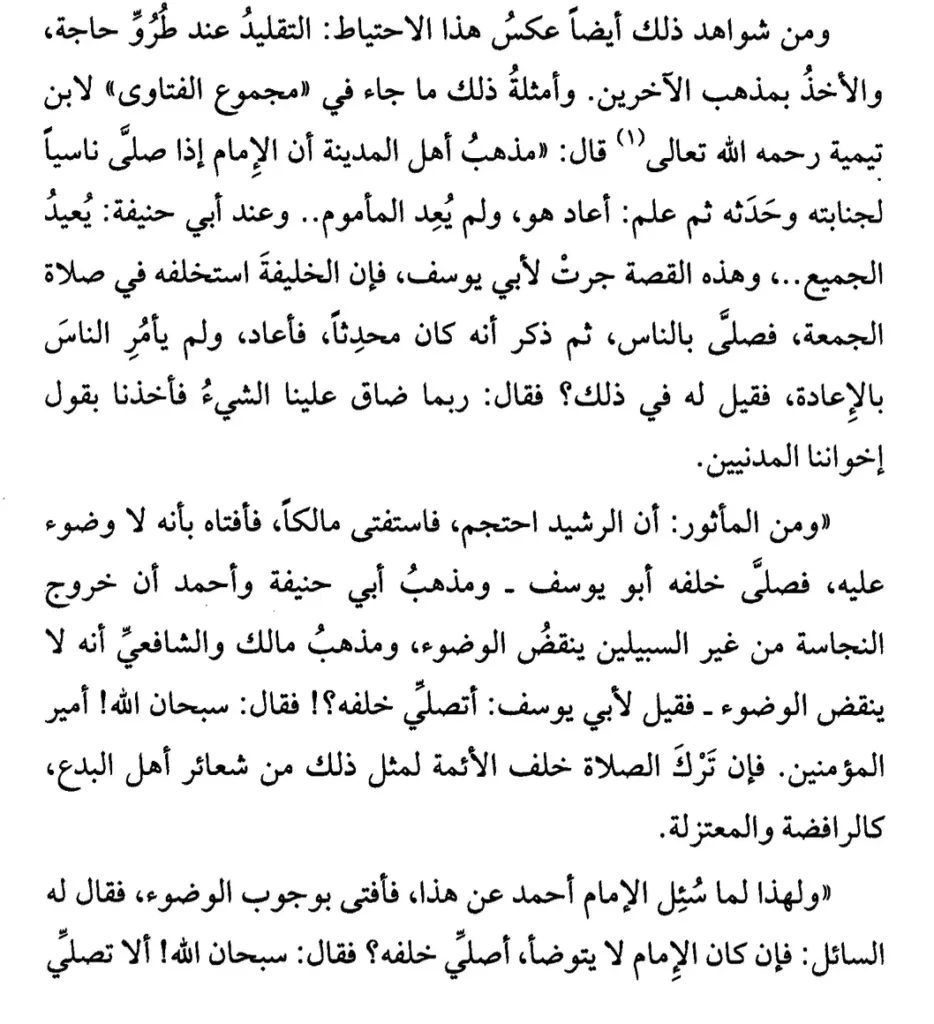
Sh. ʿAwwāmah writes:
“Among the evidences demonstrating the exact opposite of this caution is: adopting Taqlīd (following another school) when a pressing necessity arises, and taking the position of other schools. Examples of this are found in what Ibn Taymiyyah, may Allah Almighty have mercy on him, stated in Majmūʿ al-Fatāwā: ‘The view of the people of Medina is that if the Imām prays while forgetting that he is in a state of major ritual impurity (janābah) and only remembers afterward, he alone must repeat his prayer, while the congregation’s prayer remains valid and they do not repeat it. Whereas according to Abū Ḥanīfah, everyone must repeat the prayer.'”
This very scenario happened to Abū Yūsuf. The Caliph had appointed him to lead the people in the Friday prayer. He led the prayer, but later remembered that he had been in a state of ritual impurity. Consequently, he repeated his own prayer, but he did not command the people to repeat theirs. When he was questioned about this, he replied: “Perhaps when a matter becomes strictly constricted for us, we take the position of our Medinan brothers.”
Furthermore, it is related that [the Caliph] Hārūn al-Rashīd underwent cupping (ḥijāmah), and Imām Mālik gave him a legal verdict (fatwā) that his ritual purity (wuḍūʾ) remained intact. Following this, Abū Yūsuf prayed behind the Caliph.
Now, the position of Abū Ḥanīfah and Aḥmad is that the exiting of impurity from anywhere other than the two passages invalidates wuḍūʾ, whereas the position of Mālik and al-Shāfiʿī is that it does not invalidate wuḍūʾ. Thus, someone asked Abū Yūsuf: “Do you really pray behind him?!” He replied: “Glory be to Allah! [He is] the Commander of the Faithful! Verily, abandoning prayer behind the Imāms over matters like this is from the hallmarks of the people of innovation, such as the Rāfiḍah and the Muʿtazilah.”
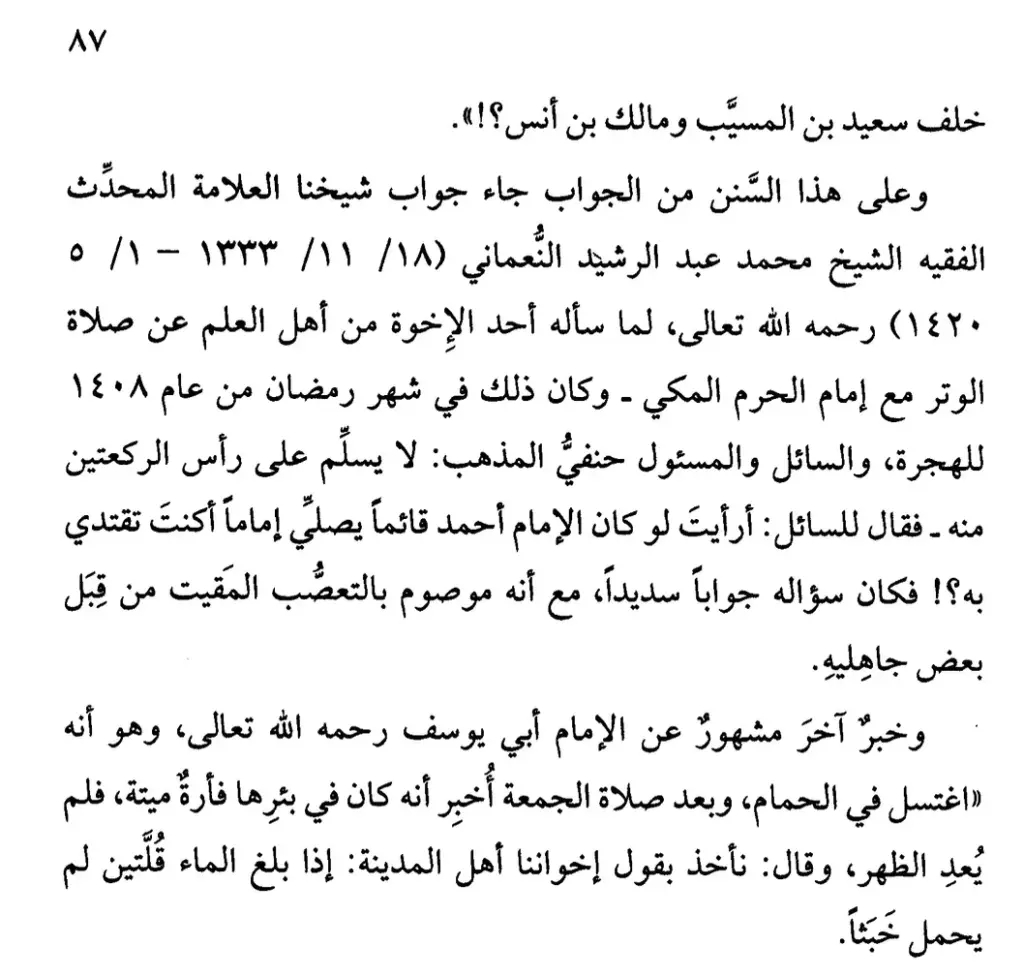
For this reason, when Imām Aḥmad was questioned regarding this same issue, and the questioner asked him: “If the Imām did not perform wuḍūʾ [after bleeding], should I pray behind him?” He replied: “Glory be to Allah! Should you not pray behind Saʿīd ibn al-Musayyib and Mālik ibn Anas?!”
Following this very path (sunan), a response was given by our teacher, the erudite scholar of Ḥadīth and jurist, Sheikh Muḥammad ʿAbd al-Rashīd al-Nuʿmānī (18/11/1333 AH – 5/1/1420 AH), may Allah Almighty have mercy on him. This was when one of the people of knowledge questioned him regarding performing the Witr prayer behind the Imām of the Sacred Mosque in Mecca (al-Ḥaram al-Makkī). This occurred during the month of Ramaḍān in the year 1408 AH.
The questioner, as well as the one being questioned, adhered to the Ḥanafī school (madhhab), which dictates that the Imām should not perform the closing salutation (taslīm) at the completion of the first two units (rakʿah) of Witr. The Sheikh responded to the questioner by asking: “Tell me, if Imām Aḥmad were standing and praying as an Imām, would you follow him in prayer?!” His question served as an incredibly astute answer, even though he [al-Nuʿmānī] had been unfairly stigmatised with hateful fanaticism (taʿaṣṣub) by certain ignorant individuals.
Another famous report concerns Imām Abū Yūsuf, may Allah Almighty have mercy on him. It is reported that he performed a ritual bath (ghusl) in a public bathhouse (ḥammām), and after performing the Friday prayer (Jumuʿah), he was informed that there was a dead mouse in the well supplying the bathhouse. However, he did not repeat the midday (Ẓuhr) prayer. Instead, he said: “We adopt the view of our brothers, the people of Medina: ‘When water reaches the volume of two qullas, it does not carry impurity.'”