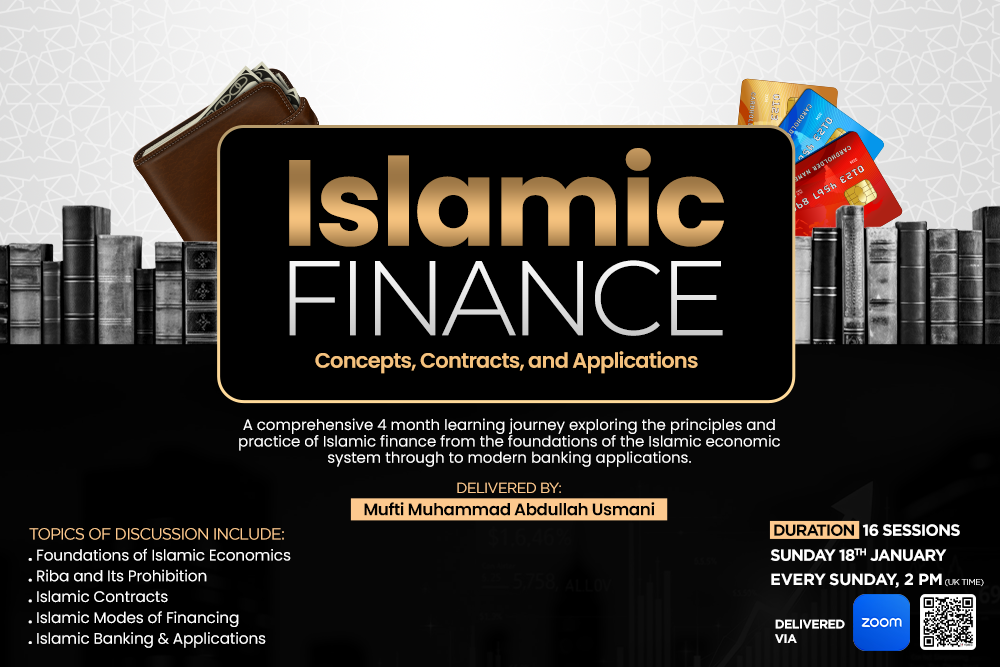
The course begins with an introduction to the Islamic economic system, delving into its modern forms, Islamic contracts, conditions, and applications in sales, including the concept of the five khiyārāt.
It provides an in‑depth study of Islamic modes of financing, beginning with mushārakah and muḍārabah, and extending to diminishing mushārakah, murābaḥah, salam, istisnāʿ, istijrār, and ijārah. Each financing mode will be contextualized with case studies to demonstrate practical application. It then shifts focus to Islamic banking, exploring models of banking in Islam, project financing, working capital management, and import/export financing.
Throughout the program, students will engage in lectures, discussions, and case studies to ensure both conceptual clarity and applied understanding.
Course & Reading Material Includes – Students will read sections from the following text:
- An Introduction to Islamic Finance – Mufti Muhammad Taqi Usmani
- Meezan Guide to Islamic Finance – Dr Imran Usmani
- Fiqh-ul-Buyu by Mufti Taqi Usmani
- Selected AAOIFI Shariah Standards
By the end of the course, participants will be equipped with both theoretical knowledge and practical skills to navigate Islamic finance in contemporary contexts.
Breakdown of Course Modules:
Module I – Foundations of Islamic Economics
- Islamic Economic System; objectives and worldview
- Factors of Production; Distribution of Wealth
Module II – Riba and Its Prohibition
- Qur’anic foundations of Riba; Riba in the Sunnah
- Types of Riba; Riba al-Fadl and Riba al-Nasi’ah
- Commercial Interest; Simple and Compound Interest
(Mid-term break for month of Ramadan)
Module III – Islamic Contracts
- Nature of contracts; essential elements and conditions
- Sale, Valid Sale, and the Five Khiyars
Module IV – Islamic Modes of Financing
- Musharakah
- Mudarabah
- Diminishing Musharakah; Murabaha
- Salam; Istisna; Istijrar
- Ijarah; Ijarah wa Iqtina
Module V – Islamic Banking & Applications
- Banking in Islam; Islamic banking models
- Project Financing; Working Capital; Import & Export Financing
Module VI – Advanced Topics
- Securitisation; Islamic Investment Funds; Principle of Limited Liability
The course is structured to be interactive, participants will have opportunities to explore supplementary research, engage with additional materials, and continue thoughtful discussion beyond the classroom to developing deeper reflection and sustained learning.
Participants are encouraged to attend the live session to benefit fully from the discussion; however, a recording will be made available to all registered students inshāʾAllāh.